
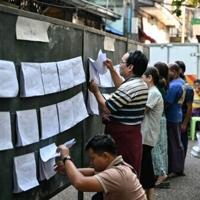

A trickle of voters made their way to Myanmar’s heavily restricted polls on Sunday, with the ruling junta touting the exercise as a return to democracy five years after it ousted the last elected government, triggering civil war.
Former civilian leader Aung San Suu Kyi remains jailed, while her hugely popular party has been dissolved and was not taking part.
Campaigners, Western diplomats and the UN’s rights chief have all condemned the phased month-long vote, citing a ballot stacked with military allies and a stark crackdown on dissent.
The pro-military Union Solidarity and Development Party is widely expected to emerge as the largest one, in what critics say would be a rebranding of martial rule.
The Southeast Asian nation of around 50 million is riven by civil war and there will be no voting in rebel-held areas.
In junta-controlled territory, the first of three rounds started at 6:00 am (2330 GMT Saturday) including constituencies in the cities of Yangon, Mandalay and the capital Naypyidaw, where military chief Min Aung Hlaing cast his ballot.
“We guarantee it to be a free and fair election,” he told reporters.
“It’s organised by the military, we can’t let our name be tarnished.”
– Slow start –
Snaking queues of voters formed outside polling stations in the last election in 2020, which the military declared void a few months later when it ousted Aung San Suu Kyi and seized power.
But this time journalists and polling staff outnumbered early voters at a downtown Yangon station near the gleaming Sule Pagoda — the site of huge pro-democracy protests after the coup.
Among a trickle of early voters, 45-year-old Swe Maw dismissed international criticism.
“It’s not an important matter,” he said. “There are always people who like and dislike.”
At another polling station near Aung San Suu Kyi’s vacant home Bo Saw, the first voter, said the election was “very important and will bring the best for the country”.
“The first priority should be restoring a safe and peaceful situation,” the 63-year-old told AFP.
But in total only around 100 people voted at the two stations during their first hour of operation, according to an AFP tally.
The run-up saw none of the feverish public rallies that Aung San Suu Kyi once commanded, and the junta has waged a withering pre-vote offensive to claw back territory.
– Electronic voting –
The military ruled Myanmar for most of its post-independence history, before a 10-year interlude saw a civilian government take the reins in a burst of optimism and reform.
But after Aung San Suu Kyi’s National League for Democracy party trounced pro-military opponents in the 2020 elections, Min Aung Hlaing snatched power in a coup, alleging widespread voter fraud.
Aung San Suu Kyi is serving a 27-year sentence for charges rights groups dismiss as politically motivated.
“I don’t think she would consider these elections to be meaningful in any way,” her son Kim Aris said from his home in Britain.
Most parties from the 2020 vote, including Aung San Suu Kyi’s, have since been dissolved.
The Asian Network for Free Elections says 90 percent of the seats in the last elections went to organisations that do not appear on Sunday’s ballots.
New electronic voting machines will not allow write-in candidates or spoiled ballots.
– ‘Repression’ –
The junta is pursuing prosecutions against more than 200 people for violating draconian legislation forbidding “disruption” of the poll, including protest or criticism.
“These elections are clearly taking place in an environment of violence and repression,” UN rights chief Volker Turk said last week.
The second round of polling will take place in two weeks before the third and final round on January 25, but the junta has conceded elections cannot happen in almost one in five lower house constituencies.
When the military seized power it put down pro-democracy protests, and many activists quit the cities to fight as guerrillas alongside ethnic minority armies that have long held sway in Myanmar’s fringes.
Zaw Tun, an officer in the pro-democracy People’s Defence Force in the northern region of Sagaing, pledged: “We will continue to fight.”
bur-jts/slb/rsc