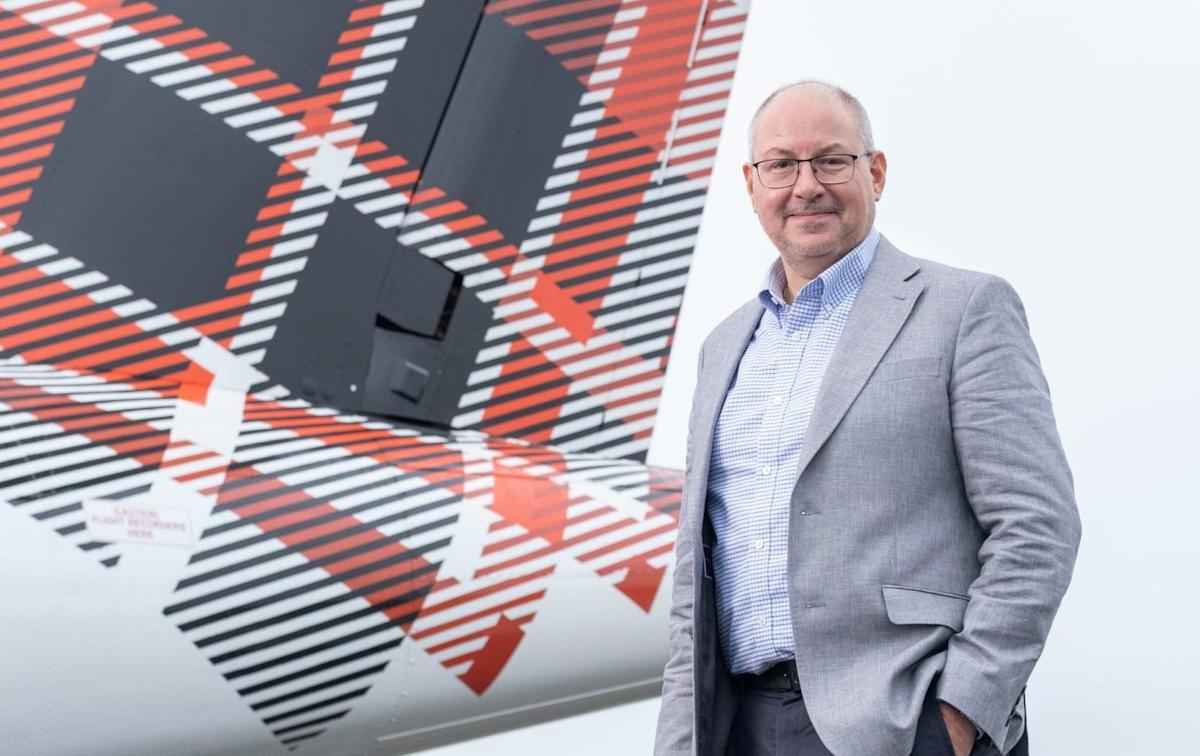
Luke Farajallah, the Loganair chief executive, says the push into electric aircraft has been supported by the Scottish Government’s interest in renewable energy
An airline best known for providing flights to some of the most far-flung parts of Britain is leading the race to develop the world’s first electric planes.
Loganair, founded in 1962 and based at Glasgow Airport, is at the forefront of global efforts to develop pioneering aircraft that produce zero emissions.
The airline has signed agreements with both Heart Aerospace, which is finalising the design of a plane combining a propeller engine with battery packs, and ZeroAvia, which is bidding to power aircraft with electricity produced from hydrogen fuel cells.
While Loganair may seem an unlikely candidate to spearhead such transformative technology, its status as a modestly sized regional airline is precisely why it is so suited to the task, according to Luke Farajallah, its chief executive.
The engines being developed by Los Angeles-based Heart and ZeroAvia, which has twin bases in Seattle and Cotswold airport in Gloucestershire, will – initially at least – produce nowhere near enough thrust to get a full-sized airliner off the runway, he said.
But if they work as advertised, they will be sufficient to power the fleet of propeller planes that Loganair uses on its routes to Scottish islands and cities across the UK.
Loganair is based in Glasgow and its routes include the world’s shortest flight – MI News/NurPhoto
Those routes include the world’s shortest flight at just 60 seconds, carrying schoolchildren between two islands in Orkney, and the only scheduled beach landing, on Barra in the Outer Hebrides. The most distant service, launched last month, is to the Channel Islands.
Mr Farajallah said the unique network, with flights averaging 35 minutes, makes the foray into electric propulsion a hard-nosed business decision rather than a net zero vision.
He said: “Caution is in our DNA. I’m happy to be the carbon warrior, but not at any cost because otherwise the customer is going to have to pay for it, and I’m pretty sure they won’t.
“But if you’re going to use less fuel and have a lower carbon footprint while lowering your costs, and the components in the engine are going to be less complicated and need changing less, then it’s a compelling proposition.
“All of these suppositions have to bear out, because if it turns out these engines need a hell of a lot more maintenance and are going to be 12 times as costly, my appetite will dwindle.”
Crucially, Mr Farajallah said the push into electric aircraft has been buoyed by the Scottish Government’s apparent obsession with renewable energy.
b’
1508 Aviation emissions
‘
He said: “It’s an environmentally friendly country and with its natural resources and ability to capture energy from wind and water it can be a platform for an airline like Loganair to move forward into a renewables strategy.”
However, Mr Farajallah questioned the speed at which both Scotland and the UK are running down the oil and gas industry, to which the fortunes of Loganair have been closely tied through its services to Aberdeen and Shetland.
He said: “Offshore oil is critically important to our business, our industry and to Scotland and it’s my view that the levers that are being pulled within Government are a bit too extreme.
“There is an assumption that everyone who is working in oil and gas will transition across to renewables, and that isn’t the case. There’s a whole range of skills that are not immediately transferable. It’s different technology, research, universities, background and experience.”
Mr Farajallah is also critical of the extent to which switching to sustainable aviation fuel (SAF), mostly derived from used cooking oil, has come to dominate thinking around decarbonising aviation, both within the industry and across governments.
With SAF costing four to five times as much as kerosene, a UK requirement to use a 10pc blend of the propellant by 2030 will push costs dangerously high for a regional airline sector where established players are already collapsing under the weight of high taxation, he said.
Mr Farajallah was previously operations chief at Flybe until 2018, formerly Britain’s biggest regional carrier until its collapse in 2020.
He also worked at Wizz Air, easyJet, British Airways and Bond Helicopters, which transported crews to North Sea oil rigs.
He said: “It’s very important not to get carried away with the SAF argument. If you’re a long-haul airline, you’ve got to look at SAF, I totally understand that.
“But when it comes to regional and ultra-short-haul flying, it is not the solution.
“We’re going to be subject to the levy and having to make the hard yards. I think that’s very unfair. It’s difficult not to be critical.”
Loganair’s bid to exploit its short-hop operating model and carve out a future independent of the costs of SAF was initially focused on Heart, which was founded in Sweden before relocating to California last April.
The firm began with plans for all-electric propulsion before developing plans for a hybrid model – much like a plug-in hybrid car – in which a battery complements a regular engine.
b’
‘
Mr Farajallah said his chief reservation about the project concerns Heart’s insistence on building not just a new propulsion system but a new aircraft to go with it.
He said: “I would prefer them to focus on the engine technology because I think that’s where they are going to get the biggest gain.
“I think they will get there, but the challenge will be certification. You’ll need a lot of battery power and a lot of batteries on the aircraft.”
Those concerns help explain Loganair’s decision to sign a parallel pact with ZeroAvia – whose fuel cell technology could be installed in existing aircraft.
The deal, struck in June, came a month after ZeroAvia announced that it would open a hydrogen fuel cell plant in Glasgow, underpinned by a £9m grant from the Scottish Government.
Mr Farajallah said: “We always liked their technology but if it’s on your doorstep it’s so much easier to engage with them and understand it.
“We looked at them, and they looked at us, and we liked what we saw. We ended up thinking that we’ve got a natural fit. They’re not just walking, they’re running fast,”
He said that while issues surrounding the storage and transportation of hydrogen remain, a fuel-cell plane is likely to enter service with Loganair in the next five to eight years, following a trial project planned by ZeroAvia in Norway.
Mr Farajallah said a “conversation” had begun with Transport Scotland about fitting the engine into one of two Twin Otter planes that operate to Campbeltown, Tiree and Barra under state-funded public service contracts.
A landing on the white sands of Barra’s beach runway would certainly be one way of ensuring that a new era of electric aviation begins with a splash.