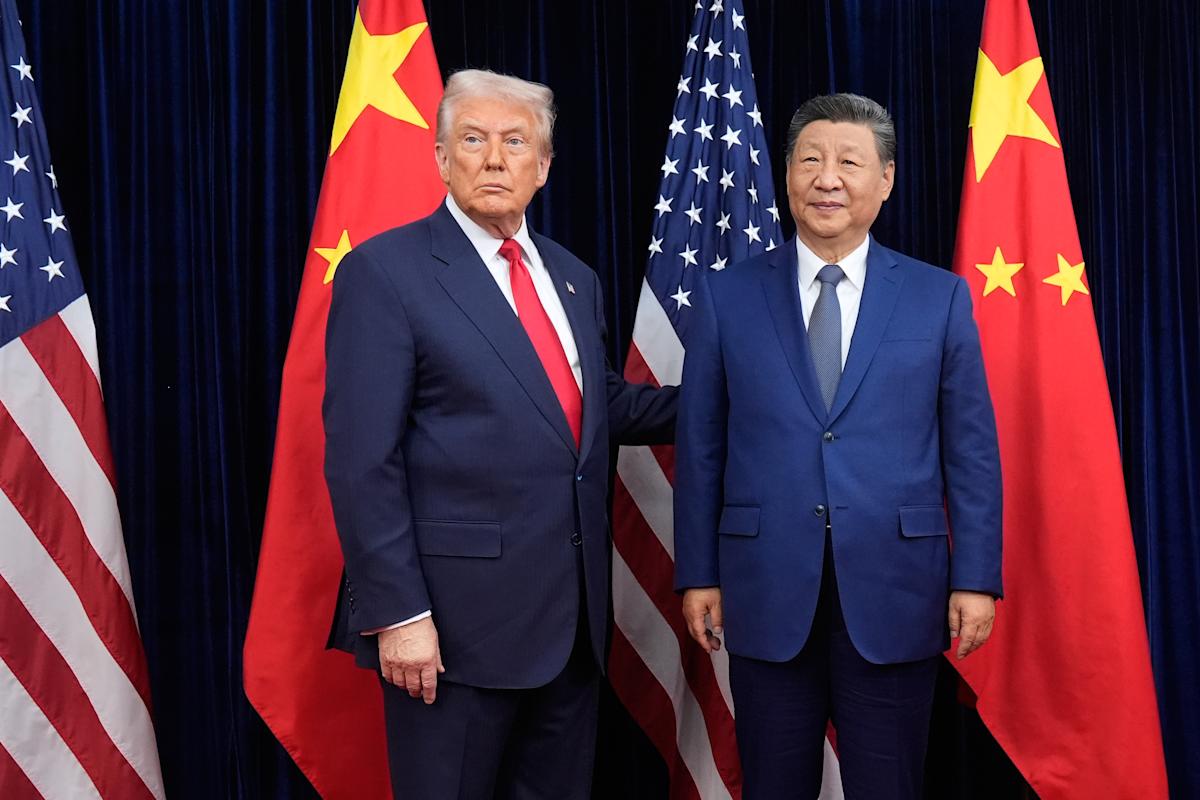
WASHINGTON (AP) — The Supreme Court decision striking down President Donald Trump’s sweeping tariffs has added a wrinkle to already complicated U.S.-China relations, with both countries navigating shifting ground to avoid an all-out trade war that would disrupt the global economy while still jostling for a position of strength in negotiations.
Friday’s court ruling would seem to strengthen China’s hand, but analysts predict that Beijing will be cautious in exploiting the advantage, knowing that Trump has other ways of levying taxes. Both sides also want to maintain a fragile trade truce and stabilize ties ahead of Trump’s highly anticipated trip to Beijing.
“It will give China a moral boost in their negotiations with Trump’s team ahead of the summit, but they are prepared for the scenario that nothing actually changes in reality,” said Sun Yun, director of the China program at the Stimson Center, a Washington-based think tank.
Furious about the defeat, Trump said first he was imposing a temporary 10% global tariff before raising it to 15% as well as pursuing alternative paths for import duties. He made the case for tariffs by pointing to China, which poses the biggest challenge to U.S. economic, technological and military dominance.
“China had hundreds of billions of dollars in surpluses with the United States. They rebuilt China. They rebuilt the army. We built China’s army by allowing that to happen,” Trump told reporters Friday. “I have a great relationship with President Xi, but he respects our country now.”
The White House has confirmed that Trump will travel to China on March 31 through April 2 to meet President Xi Jinping.
Xi is unlikely to “flaunt or brandish” the Supreme Court ruling forcefully when meeting Trump, likely choosing instead to try to strengthen his rapport with the U.S. president, said Ali Wyne, a senior research and advocacy adviser focused on U.S. policy toward China at the International Crisis Group.
The more that Xi can do that, “the more likely it is that the fragile trade truce between the United States and China will take hold in earnest and that Trump will be amenable to security concessions that give China greater freedom of maneuver in Asia,” Wyne said.
Asked for comment on the implications of the court ruling, Chinese Embassy spokesperson Liu Pengyu said only that tariff and trade wars serve neither country’s interest. He called for Beijing and Washington to work together to “provide greater certainty and stability for China-U.S. economic and trade cooperation and the global economy.”
The court decision also creates new uncertainty for other U.S. trading partners, in Asia and elsewhere, especially those that have reached trade deals to calm the initial turmoil from Trump’s tariffs.
“I would expect most Asian partners to proceed cautiously, with existing agreements largely holding as both sides work through the implications in the coming weeks,” said Dan Kritenbrink, a partner at The Asia Group who served as assistant secretary of state for East Asian and Pacific affairs in the Biden administration.
He said he would be watching the impact on Japan ahead of Prime Minister Sanae Takaichi’s planned visit to Washington in March. Japan, a staunch U.S. ally, has seen its relations with Beijing deteriorate in recent months.
Shortly after Trump returned to the White House early last year, he invoked an emergency powers law and slapped 20% tariffs on Chinese goods over what he said was Beijing’s failure to stem the flow of chemicals that can be used to make fentanyl.
Trump later invoked the same emergency authority to impose sweeping reciprocal tariffs on many countries, including 34% on China. Beijing retaliated, and the tariffs temporarily soared to triple digits before both sides climbed down.
After several rounds of trade talks and a summit between Trump and Xi in South Korea in October, the two countries agreed to a one-year truce with a 10% baseline tariff. Trump also slashed the so-called fentanyl tariff to 10%, while Beijing resumed its cooperation in restricting the export of more substances that could be used to make the opioid.
Wendy Cutler, vice president of the Asia Society Policy Institute, said she suspected the Trump administration could roll out a Plan B quickly. The Office of the U.S. Trade Representative has an active investigation into China’s compliance with a previous trade agreement and that could be the administration’s backup plan, she said. If China is found not to be fulfilling its obligations under the agreement, the U.S. government is allowed under a trade law to impose tariffs.
Rep. Ro Khanna, the top Democrat on the House Select Committee on the Chinese Communist Party, urged the administration to come up with a new, tougher strategy that “holds China accountable for its unfair trade practices and leverages the collective power of our allies and partners.”
Gabriel Wildau, a managing director focused on political risk analysis in China at the consultancy Teneo, said Trump has already shown his willingness to use other legal authorities to impose tariffs on China, as he did during his first term, and Beijing probably assumes that the tariffs could be maintained or re-created “with only modest difficulty.”
“But Beijing also holds out hope that they can persuade Trump to lower this tariff in exchange for purchase guarantees or other concessions,” Wildau said.