The Social Security Fairness Act signed at the beginning of 2025 is now unfair, at least when it comes to taxes, according to some representatives in Congress.
Those income spikes last year likely triggered more taxes for many people, experts said. To help address the potential tax bomb, Rep. Lance Gooden, R-Texas, introduced earlier in February the bipartisan No Tax on Restored Benefits Act to amend the tax code to exclude retroactive Social Security payments tied specifically to the repeal of WEP and GPO from federal taxable income.
“For hundreds of thousands of Americans, the bipartisan Social Security Fairness Act was truly transformative, ensuring they received the benefits they deserved,” said Rep. Chellie Pingree, D-Maine, cosponsor of the bill, in a news release. “But it was never intended to saddle widows, low-income seniors, and dedicated public servants with an unexpected tax bill.”
How much of people’s Social Security benefits will get taxed depends on the total amount of their income, including tax-exempt interest like from a municipal bond, plus one-half of their Social Security benefits for the taxable year.
Up to 85% of your Social Security benefits can be taxed depending on how much more that combined income is over the base amount for your filing status.
The base amounts based on filing status are:
$25,000 if you’re single, head of household, or qualifying surviving spouse
$25,000 if you’re married filing separately and lived apart from your spouse for the entire year
$32,000 if you’re married filing jointly
$0 if you’re married filing separately and lived with your spouse at any time during the tax year.
If you’re married and file a joint return, you and your spouse must combine your incomes and Social Security benefits when figuring the taxable portion of your benefits. Even if your spouse didn’t receive any benefits, you must add your spouse’s income to yours when figuring on a joint return if any of your benefits are taxable.
The Social Security Administration provides a tool to help calculate whether Social Security benefits are taxable and if so, how much.
Aside from the higher share of taxable Social Security benefits, beneficiaries will also have to watch their overall income tax bracket, said Jaime Eckels, certified financial planner and Wealth Management Partner with Plante Moran Financial Advisors.
“The payments could also push individuals into a higher tax bracket or IRMMA bracket, affecting Medicare premiums,” she said.
IRMAA stands for Income-Related Monthly Adjustment Amount, which is a surcharge added to Medicare Part B and Part D premiums for people with higher incomes.
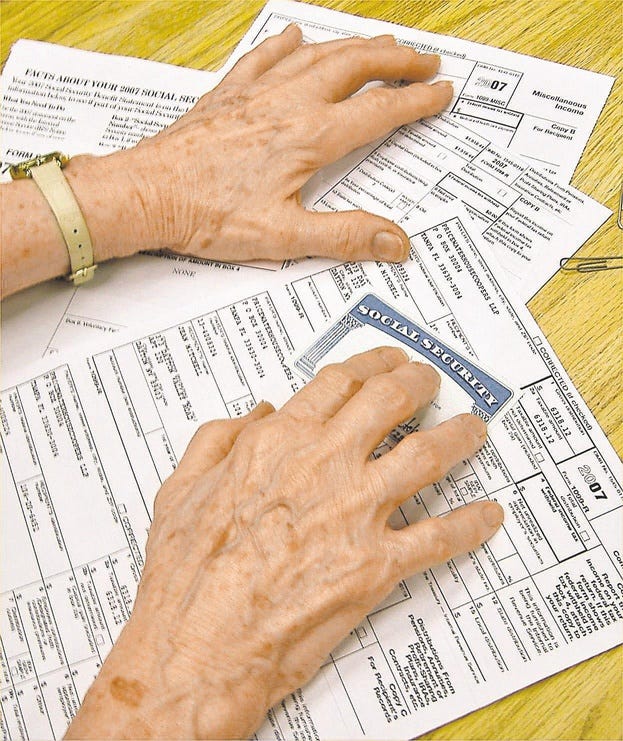
Published caption: Jean Mitchell/Dayton Courier Pictured here are documents needed to file for the rebate including a Social Security card, statement of earnings or a Social Security benefits statement for 2007, and any 1099Rs listing various distributions, such as those from pensions and annuities.
Some experts said they doubt the bill to amend the tax code would pass.
“The chances that anything passes in this Congress is fairly low, in my opinion,” said Phillip Hulme, owner of Stars & Stripes Financial Advisors. “I think last year set a record for the least amount of legislation passed of any class of Congress.”
But also, never say never.
“Maybe this is one of the few things they (politicians) can use to rally some support for themselves,” he said. “After all, who doesn’t like free money?”
People have a few options they can try to avoid more taxes. They include, experts say:
If the lump-sum retroactive payment pushes your combined income above the thresholds for the tax on Social Security, the IRS will allow you to allocate it to the year you should have received it, Eckels said. You don’t have to “amend” your prior year’s tax returns either. Instead, you check the box on line 6c of your Form 1040 or 1040-SR if it lowers the taxable portion of your benefits and pay any taxes owed for the prior year with your current year’s tax return.
Contact your local Taxpayer Assistance Center or certified public accountant to get guidance on avoiding increases in Medicare IRMAA. “Since the back pay is not expected to continue, they could argue that their income is expected to be reduced and that they may qualify for an IRMAA exclusion,” Hulme said. “Form SSA-44 would need to be filed to claim the exception but since this is a novel use case, I can’t say for sure what the IRS will determine.” But it’s worth a try, he said.