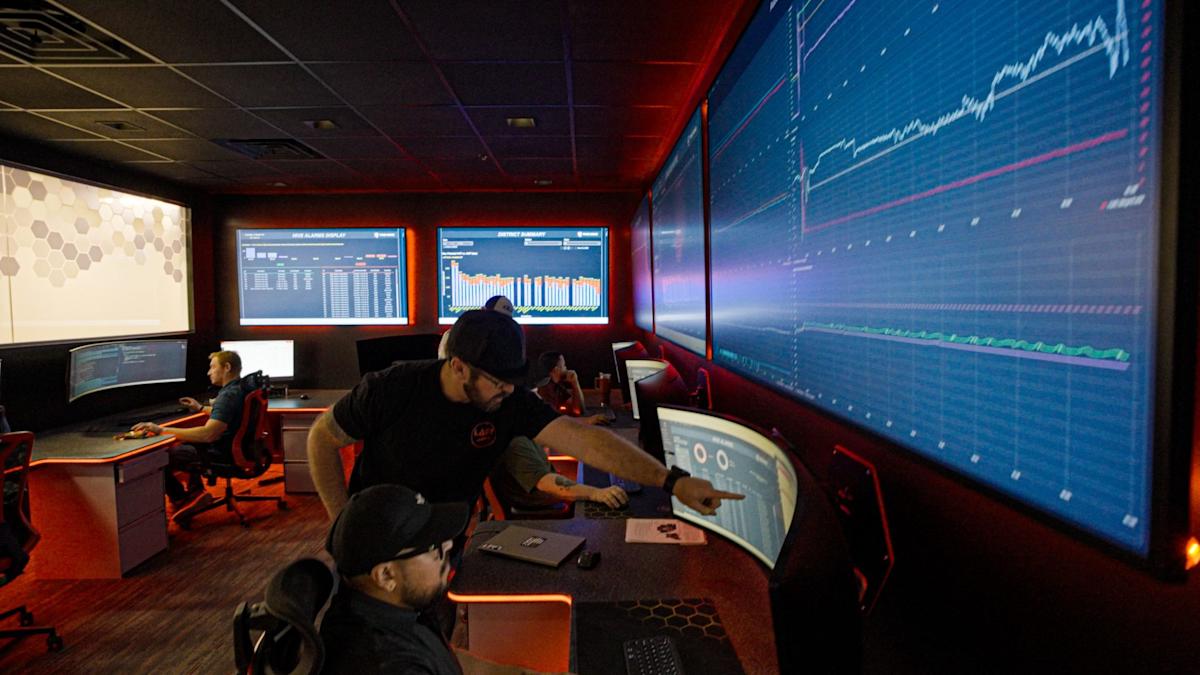
Enter the “Hive.” Just outside of Denver, a small team of people oversees Liberty Energy’s entire fleet of fracking operations nationwide, largely to supervise the AI-automated work with human eyes.
Instead of golden honey, the Hive facilitates the churning out of millions of barrels of black gold—the crude oil produced from Liberty’s increasingly AI-dominated hydraulic fracturing, called fracking, that now requires fewer crews and people. Amid lower oil prices and activity levels, those savings are key.
Liberty, founded 14 years ago by President Trump’s new Energy Secretary Chris Wright, is now led by CEO Ron Gusek, as the company has grown into a U.S. fracking leader along with the more household name of Halliburton. The companies are leaning into autonomous, digitalized oilfields for safer, faster, cleaner (on a relative basis) and, ultimately, more cost-efficient work.
The combination of horizontal drilling and fracking revitalized the U.S. oil industry 20 years ago. Fracking means pumping millions of pounds of sand and millions of gallons of water and chemicals into each well with the necessary pressures to release the oil and gas. The intensity of the fracs has increased substantially—more and more sand and water per well—as have the downhole visualizations and the ability to optimize the frac job along each foot of these 20,000-foot wells. And much more of that work is now AI controlled.
“We are rapidly getting to full deployment—I expect by the end of this year we’ll be there—where this will all be done via AI computer algorithms,” Gusek said. “That’s not something a human can do. The role on location evolves a little bit from an operator deciding the throttle position and gear each pump was in to now providing oversight as a computer executes all that work, and does so at a level of efficiency we just simply couldn’t achieve before.”
More tech-savvy workers monitor from the Hive and on-site data vans while requiring less manual labor. The wells are drilled much longer and more are fracked at once—called simul-frac—so fewer rigs, frac fleets, and people are required. The U.S. oil and gas workforce has plunged 35% in just over a decade and the number of frac fleets is down 50% in six years, while U.S. oil production sits near world-leading, all-time highs despite recent signs of plateauing with oil prices down.
Liberty’s AI-driven, automated frac spread is controlled by its StimCommander system and augmented by the Forge learning cloud platform to continuously improve operations.
“The job of the classic roughneck is definitely evolving. It’s getting more sophisticated,” Gusek said. “The assets are getting larger and more automated. That means we don’t need as many people out there. We are arguably victims of our own success. That’s a good thing. That keeps the cost of energy low for humanity.”
Liberty, Halliburton, and others are switching to modern electrified frac fleets that don’t require dirtier diesel fuel.
The fleets break down less often and the Hive uses Liberty’s “FracPulse” AI to predict any potential maintenance problems, courtesy of the real-time analysis of roughly 1 billion data points per day, Gusek said. In just a few months, he said, Liberty is doubling the life of much of its equipment.
“Rather than it become a major maintenance event, instead it’ll be a very minor maintenance event that could be addressed quickly on location,” Gusek said.
And, because there are still people in the oilfield, an AI-operated, 360-degree camera system alerts people in real time if they inadvertently step into the “line of fire” near moving equipment or trucks at a busy frac spread. “That was impossible with machine learning or Big Data analysis, but that is possible with AI,” Gusek said.
All of these improvements equate to less downtime and more speed, said Dan Pickering, founder and chief investment officer for Pickering Energy Partners consulting and research firm
“The days to complete a well are down notably. What are we attributing that to?” Pickering said. “It’s more AI and well-site automation, it’s an ability to see the subsurface, it’s the mindset that says, ‘We can do this faster, and we are.’ I think it’s the amalgamation of the technologies, not one specific one.”
Supply chains also are critical and often overlooked. For the U.S. oil industry, one of the biggest pain points is the delivery of tons and tons of sand for fracking.
Atlas Energy Solutions is now deploying driverless RoboTrucks to ship the sand on private lease roads in controlled environments. But the tech isn’t quite ready for busy highways.
Liberty’s solution is its Sentinel AI program to control the demand forecasting and the scheduling of every truck for the company’s roughly 1 million truck trips per year. The AI already has led to the elimination of 30% of the needed trucks, Gusek said.
“It used to be somebody’s job on location to try to control the cadence of trucks. Because they don’t want to be short on sand, the default was to line up eight or 10 of them and just have them sitting there waiting to offload,” Gusek said. “It means we never run out of sand, but it’s very, very inefficient for the driver. He spends an hour sitting waiting to unload instead of making roundtrips.”
That’s Liberty and the oil industry aim to survive for longer—fewer trucks, fewer rigs and fleets, fewer people, fewer emissions—fewer of everything, while producing the same or greater results. Time will tell.
This story was originally featured on Fortune.com