A key market data point is signaling fear about America’s economy
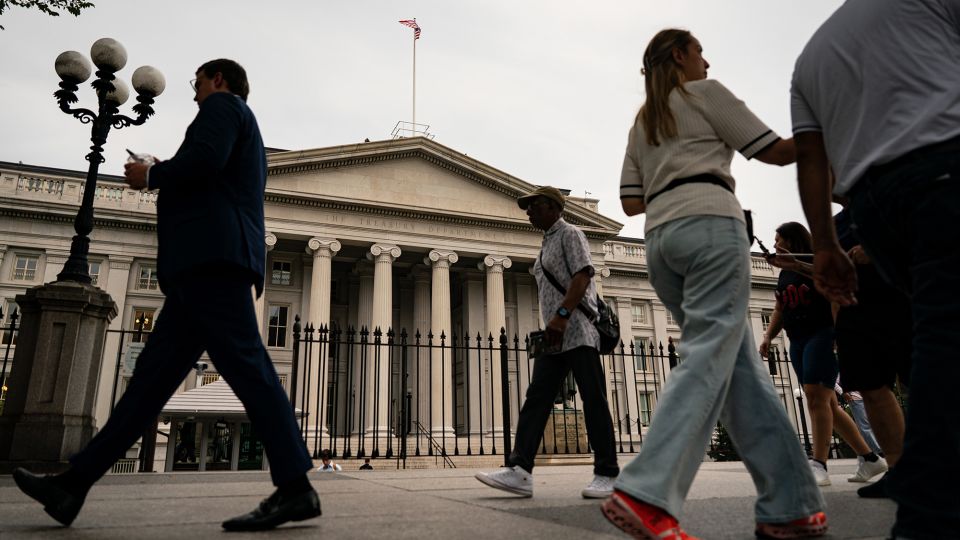
Bonds are rallying as investors seek safe havens and try to lock in rates ahead of expected Federal Reserve interest rate cuts. – Al Drago/Bloomberg/Getty Images
While the stock market hovers near record highs, a shift in the bond market is signaling mounting concerns about the economy’s health.
A bevy of data this month showed the labor market is on shakier ground than previously thought. That spurred a rally in bonds as investors sought safe havens and ramped up bets that the Federal Reserve will cut interest rates this week.
As bonds rallied, it pushed yields lower: The two-year Treasury yield this month hit its lowest level since 2022, and the 10-year yield hit its lowest level since April, when President Donald Trump announced an unprecedented tariff campaign that sparked fears of an economic slowdown.
The decline in Treasury yields shows markets are adjusting to the reality of a weaker-than-expected job market and expectations for potentially subdued economic growth.
The Fed, which has held its benchmark interest rate steady since December, is widely expected to lower rates at its policy meeting this week amid a slowing labor market. Investors are flocking to Treasuries to lock in the current relatively high rates ahead of expected Fed rate cuts.
Labor Department data released on Thursday showed one of the biggest weekly increases in jobless claims in more than a year. That came after separate data earlier this month showed the unemployment rate in August ticked up to 4.3%, its highest level since 2021. The US economy also added 911,000 fewer jobs for the year ending in March than previously thought, according to Bureau of Labor Statistics data this month.
Treasuries are seen as relatively risk-free assets because they are backed by the full faith and credit of the US government. When investors expect a slowdown, they often move cash into Treasuries as a sure bet to ride out the uncertainty.
“The bond market is acknowledging that job creation, a powerful engine of the US economy, is decelerating,” said Chip Hughey, managing director for fixed income at Truist Advisory Services.
The two-year Treasury yield tracks expectations for the Fed’s rate policy, and has swiftly dropped as markets have adjusted to the prospect of rate cuts. The 10-year yield, meanwhile, tracks expectations for economic growth.
“The yield declines we are seeing right now can be viewed as a recalibration for an expected step-down in economic activity — not recessionary — but softer in comparison to the past few years,” Hughey said.
The 10-year yield — a key benchmark for borrowing costs across the economy — fell from 4.27% at the start of the month to briefly dip below 4% on Thursday.
A decline in the 10-year yield can lead to lower mortgage rates and more affordable loans. But a swift decline in the 10-year yield is not always a good sign: It could signal investors think the economy is weakening.
“Yields are coming down because the market is expecting slower growth ahead,” said Kathy Jones, chief fixed income strategist at Charles Schwab. “That’s the assumption behind why the Fed will cut rates, because the job market is deteriorating.”
Matthew Luzzetti, chief US economist at Deutsche Bank, on Friday said he raised his expectations for interest rate cuts this year. Luzzetti now expects three quarter-point cuts across September, October and December.
“With recent data showing further weakness in the labor market and somewhat more modest inflationary pressures than anticipated, we have brought forward one rate cut from next year,” Luzzetti said in a Friday note.
Bank of America earlier this month also revised its expectations for the Fed to cut interest rates. The bank now expects a quarter-point cut in September and December, after previously forecasting zero cuts this year.
“The August jobs report is likely to amplify the Fed’s concerns about labor market weakness,” Aditya Bhave, senior US economist at Bank of America, said in a September 5 note.
It’s unclear how much interest rates will be slashed. Traders are pricing in a 96% chance the Fed will cut its benchmark interest rate by a quarter point this week, with a 4% chance of a jumbo half-point cut.
While investors are adjusting to the reality of a weaker labor market, consumer spending this year has remained relatively robust, supporting outlooks for economic growth, according to Bill Merz, head of capital markets research at US Bank Asset Management Group.
Consumer spending rose 0.5% from June to July, according to Commerce Department data. Economic growth in the second quarter, as measured by gross domestic product, also came in stronger than expected.
“Consumer spending continues to be the engine for growth,” Merz said. “We’re not seeing signs of that cracking yet, but we’re watching that carefully, because there’s obvious weakening in the labor market at this point.”
And while nerves about a labor market slowdown are at the forefront of investors’ focus, concerns about inflation still linger.
The Fed is in a tricky spot, balancing a weakening labor market while inflation remains relatively elevated. A core measure of Consumer Price Index that excludes volatile food and energy prices rose 3.1% year-over-year in August, according to data from the Bureau of Labor Statistics. That’s well above the Fed’s target of 2%.
“Short-term (borrowing) rates are coming down faster than long-term rates, and that is also a bit of a signal of concerns about long-term rates and how much they can decline in this environment of a great deal of uncertainty about fiscal deficits, inflation remaining high and not turning lower,” said Jones of Charles Schwab.
For more CNN news and newsletters create an account at CNN.com