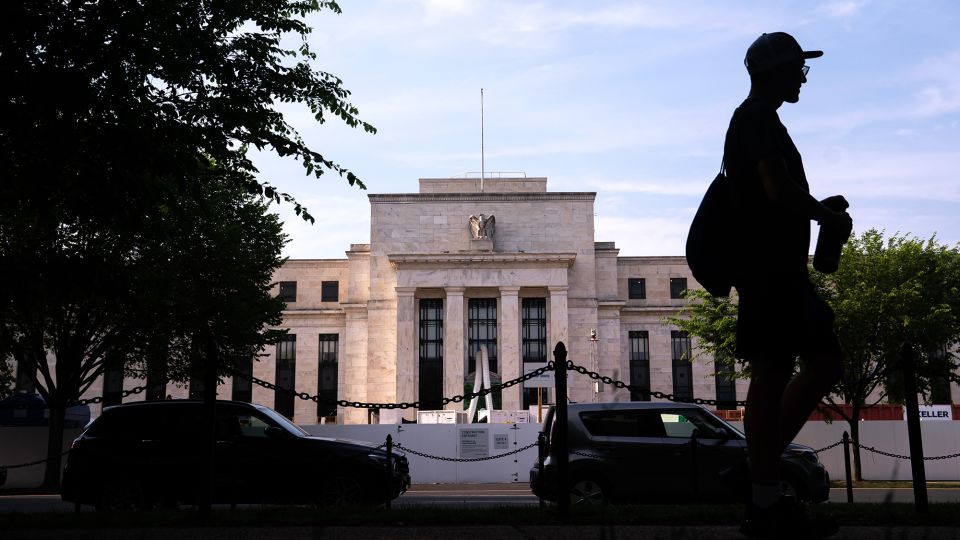
A pedestrian passes the Marriner S. Eccles Federal Reserve building in Washington, DC, in June 2023. – Nathan Howard/Bloomberg/Getty Images
With a pivotal Federal Reserve meeting coming up this week, America’s central bankers are confronted with an all-too-familiar question: Is it already too late to step in?
In just a few days, the central bank is expected to lower interest rates for the first time since December to shore up America’s crumbling labor market. Unusually weak hiring in recent months has locked in a rate cut, according to futures, with perhaps a few more by year’s end. But some central bankers — namely, Fed governors Christopher Waller and Michelle Bowman, both appointed by President Donald Trump — say the Fed should have cut interest rates in July, echoing Trump’s loud demands to lower borrowing costs.
During a speech in Miami on August 28, Waller — a potential Fed chair candidate — said monetary policy risks “falling behind the curve” if economic conditions continue to weaken.
Fed governors Michelle Bowman and Christopher Waller during a conference on monetary policy in Palo Alto, California, in May 2022. – Ann Saphir/Reuters
Fed officials wait for months of data before deciding to pivot on rates, but it’s notoriously difficult to time with razor-sharp precision. That timing is crucial because it can impact the jobs of millions of Americans and whether inflation shoots higher. In 2021, the Fed was criticized for responding too late to rising inflation.
In 2025, getting the timing right for rate cuts is an even tougher task with Trump’s widespread tariffs already pushing up some prices and the US labor market hitting a lull in hiring.
And whether the Fed has already missed its cue is “the million-dollar question that I think no one knows the answer to,” Brent Schutte, chief investment officer at Northwestern Mutual Wealth Management Company, told CNN.
Economic forecasters don’t always get it right — and neither does the Fed.
In 2021, some economists and Fed officials, including Fed Chair Jerome Powell, said a bout of inflation would prove to be only “transitory,” which ended up not being the case. And, in 2023, forecasters and Fed economists predicted a recession that never happened.
“The Fed isn’t any better at reading the tea leaves than all the other private forecasters out there,” said Kent Smetters, an economics professor at the University of Pennsylvania’s Wharton School.
The central bank has to factor in abstract concepts, such as the lagging effects of interest rates and the so-called neutral rate of interest, the point where borrowing costs neither stimulate nor dampen economic activity.
Federal Reserve Chair Jerome Powell speaks during a news conference in Washington, DC, on July 30, 2025. – Mandel Ngan/AFP/Getty Images
Despite central bankers’ good-faith attempts to right-size their policy in a timely manner, there isn’t a science to it and they could be off-point. – Alex Wong/Getty Images
“Monetary policy lags in terms of how much it stimulates the economy, so, ideally, it should move a couple months ahead of weaker jobs numbers,” said Smetters. “But the Fed also can’t place a lot of weight on data for a single month or even two.”
Last year, the unemployment rate climbed quickly in a short period and there was similar criticism that the central bank was too late to lower rates. Then the Fed stepped in with a bold half-point rate cut to stave off further weakening.
By the end of last year, it turned out that the labor market wasn’t falling off a cliff: In December, employers added a massive 323,000 jobs as the unemployment rate edged down from the prior month to 4.1%.
The Fed’s efforts last year showed that despite central bankers’ good-faith attempts to right-size their policy in a timely manner, there isn’t a science to it and they could be off-point.
Powell has said that if it weren’t for Trump’s trade war, the Fed would have already lowered interest rates at this point this year.
Instead, Trump’s unprecedented tariffs have squeezed businesses and begun to erode American consumers’ purchasing power. This has threatened both sides of the Fed’s dual mandate — stable prices and maximum employment.
According to the Fed’s preferred inflation gauge — the Personal Consumption Expenditures price index — inflation of goods exposed to tariffs, such as appliances and furniture, has already crept up and could continue to rise in the months ahead.
But several Fed officials have warmed up to the idea that tariff inflation may be short term, possibly resulting in only a one-time price adjustment.
Products line the shelves in a home decor and furniture store on June 16, 2025 in Miami, Florida. President Donald Trump’s unprecedented tariffs have squeezed businesses this year. – Joe Raedle/Getty Images
San Francisco Fed President Mary Daly wrote in a recent social media post that “tariff-related price increases will be a one-off.” St. Louis Fed President Alberto Musalem said as much at a September 3 event, stating that he expects “the effects of tariffs will work through the economy over the next two to three quarters and the impact on inflation will fade after that.”
Not only does the tariff situation remain highly uncertain, despite Fed officials’ higher hopes that tariff inflation may be limited, but so does the future of the labor market.
Before Powell opened the door to rate cuts in his keynote speech at the Kansas City Fed’s annual economic symposium last month, the Fed chief had repeatedly described the labor market as “solid” with some “downside risk.” But the most recent federal data showed that the labor market was on shakier footing than previously thought.
Last week, the Labor Department reported that US job growth in the year ending in March was running at a much slower pace than previously reported. Job gains were revised down by 911,000 during that period, the biggest downward revision on record. Since March, job growth has continued to slow to a crawl, with more industries shedding jobs than adding.
“Labor market momentum is being lost from an even weaker position than originally thought, reinforcing expectations of meaningful interest rate cuts,” James Knightley, chief international economist at ING, said in a September 9 note after the benchmark revision was released.
Chicago Fed President Austan Goolsbee said in a speech last month that the Fed’s meetings this fall will be “live,” meaning policy decisions will not be obvious and will be subject to incoming data.
“We’re going to have to figure it out,” he said.
For more CNN news and newsletters create an account at CNN.com